


How and Where to Use Granite?
Granite is known for its strength and robustness. This is due to the formation of jointed minerals during the slow cooling of magma bubbles. Additionally, the minerals it contains include feldspar, quartz—both known for their hardness—and mica, which makes up 20% of the composition. Granite is also resistant to shocks and extreme temperatures, does not scratch, does not freeze, and is a good conductor of heat. These qualities make granite a versatile construction material.
Therefore, granite is used in the following areas:
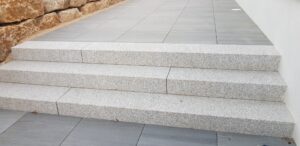
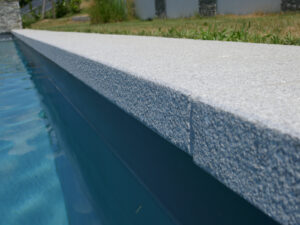
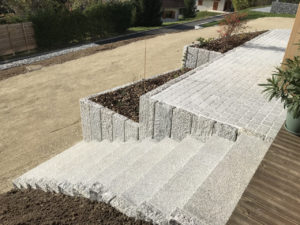
- In landscaping: steps, retaining walls, pool coping, fountains, basins, terraces, and pathways with granite paving or tiles.
- In urban landscaping: furniture, pillars, bollards, roadways, paving, and borders for memorial stones.
- In major construction: bridges, buildings, monuments, etc.
- For interior design and decoration in kitchens (worktops) and bathrooms (wall tiles).
-

- Marches en granit
-
- Margelle de piscine en granit Alto Douro
-
- GAD MAR 06
What are the Main Uses of Granite?
Granite is a robust material mainly used outdoors but also indoors. It can be available in various formats. Granite is commonly chosen for paving and tiling due to its strength and durability.
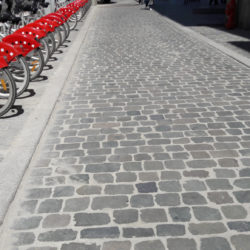
Carriageable granite paving can be used in the renovation or construction of roads and driveways for vehicles. Sawn or thinner granite paving is suitable for pedestrian streets, squares, or creating terraces. Paving is available in a variety of sizes, shapes, finishes, and colours, offering great flexibility for landscaping projects.
-
- Sawn Lyon granite setts
-
- Pavés Napoléon – joint gazon
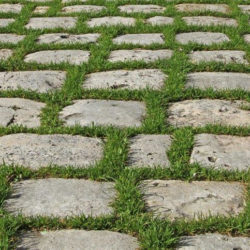
-
- Pavés granit de Lyon

Granite can also be used in different formats of tiling. Granite slabs are commonly employed to create terraces and pool edges due to their aesthetics and durability. Copings and borders made from granite are also used for outdoor landscaping such as terraces and pool edges.
Granite copings and borders can be custom-cut to suit any landscaping project, offering an elegant and cohesive appearance. In addition to its aesthetic use, granite offers exceptional durability and resistance, making it an ideal choice for paving and tiling projects.
How to Lay Granite Paving?
Laying granite paving consists of 3 main steps: planning and preparing the area to be paved, groundwork and foundation, and laying the paving with jointing and cleaning. Each step must adapt to the terrain’s configuration, the usage (pedestrian or carriageable), and the format of the chosen paving.
Step 1: Planning and Preparing the Area to be Paved
This step begins with studying your terrain to select the right materials and ensure a strong granite paving. Mark the area to be paved using string lines and measure the space to purchase the appropriate amount of materials. In your plan (and work), include a 2% slope for rainwater drainage, potential pipe passages, and the installation of channels. Consider the layout and the aesthetic pattern you want for the granite paving: arch layouts, circles, herringbone, cross joints, or aligned lines, etc.
Step 2: Groundwork and Foundation
Excavate the ground to a depth equal to the height of your paving plus 20 cm, or up to 40 cm if the area is vehicle-accessible. Compact the soil. Then, lay a geotextile layer to prevent plant growth and avoid material mixing. Create a base layer (using aggregates, gravel, crushed stones, etc.). Compact everything with a vibrating plate and ensure the ground is level.
Step 3: Laying the Granite Paving
Spread the bedding layer composed of either stabilised sand, crushed sand (0/4), or mortar (a mixture of sand, cement, and a little water) to a height of 4-5 cm, then level it with a spirit level. Lay the granite paving directly onto the bedding, ensuring a 1-3 cm gap between the paving stones. Compact the paved area with a vibrating plate to ensure a perfect level finish.
-
- Pose de pavés carrossables anciens

-
- Escalier paysager en granit et traverse de chêne
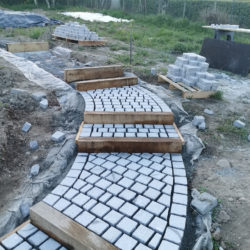
-
- Laying large setts on mortar
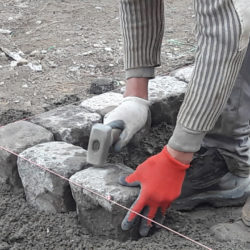
Laying on a Concrete Slab:
Have you already poured a concrete slab on the area to be paved? It is possible to lay granite paving directly on your slab. First, ensure that your slab is defect-free, solid, and dry. Clean the surface if needed and then apply a primer to strengthen the bond between the concrete slab and the adhesive or mortar. Use adhesive if your paving stones are pre-measured; otherwise, apply a thick mortar. Regularly check the level to ensure proper alignment.
Jointing and Cleaning:
Once your paving is laid, fill the joints with either thick mortar or polymer sand. Follow the installation instructions for the joint material selected. Finally, clean the surface to remove any mortar residue using clear water and/or an appropriate cleaning product.
