


What are the stages of granite production?
Extracting granite blocks is the first crucial step in the production of this prized natural stone.
Granite Extraction:
Granite extraction is a vital step in the production process of this natural stone. Various extraction techniques are employed depending on the characteristics of the quarry and the type of rock.
The primary aim of these techniques is to preserve the integrity of the rock and its physical properties to obtain high-quality granite blocks for the subsequent shaping stages.

Extraction using explosives:
Extraction begins by drilling holes into the rock mass around the granite to be extracted. Once the holes are made, a specific explosive, which acts through expansion, is used to detach the rock. This helps prevent unwanted cracks and preserves the stone’s quality.
Extraction by wire saw:
This method is employed to clear large rock masses that would be difficult to cut with explosives.
The process involves rotating a steel cable equipped with diamond beads that saw through the rock mass. This enables the creation of granite blocks in suitable sizes for the next stages.
Both extraction methods, using explosives and wire saws, can be combined depending on the quarry’s configuration.
Once granite blocks are extracted from the quarries, they are transported to processing facilities or processed directly in the quarry. The transformation and shaping stage is crucial to giving granite its form and final finishes according to the desired product type (paving stones, slabs, curbs, etc.).
Granite Transformation and Shaping:
Cutting the Blocks:

Cutting granite with a diamond disc
The first transformation process involves cutting granite blocks into slices or thinner slabs. Special saws equipped with diamond discs or cables are used for this purpose. Cutting can be done automatically or manually, depending on the size of the blocks and the specific project requirements.
Shaping and Finishing:
Pre-cut granite blocks are then shaped and cut according to the specific needs of the project and the desired product.
Machines are used to achieve precise cuts and complex shapes. Whether for custom slabs, paving stones, curbs, or fountains, granite can be shaped to meet custom dimensions.
-

- Découpe du granit à l’aide d’une presse pour façonner des pavés

-
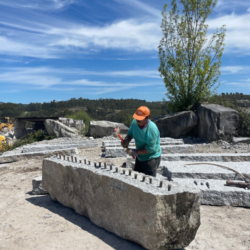
- Découpe et taillage de la pierre manuellement en carrière
Finishes:
Many finishes can be applied to granite to modify the surface appearance, including variations in colour and texture depending on the treatment applied.
Most surface treatment and finishing operations are automated due to the hardness and resistance of granite and the time-consuming nature of the tasks.
However, there are operations where manual finishing is indispensable, such as stone carving, polishing, engraving, and others. Through these manual operations, the final product achieves a handcrafted finish and a unique touch.
This may include finishes such as bush-hammered, flamed, shot-blasted, sandblasted, polished, brushed, or aged, which add texture and can lighten or darken the granite’s surface tone.
Quality Control:
At every stage of the transformation and shaping process, strict quality control is carried out to ensure that the granite meets required standards. This includes checking the colour, texture, resistance, and the absence of defects or cracks that could affect the durability and appearance of the final material.
Packaging and Transport:
Regarding packaging and transport, except for special pieces that require specific protection due to their size or fragility, finished products are typically packaged either on pallets or in big-bags (strong, flexible sacks), especially for paving stones.
The primary aim of packaging is to ensure the safety and protection of finished products during transport, minimising the risk of damage or breakage. It also facilitates the loading, unloading, and storage of products while maintaining their integrity until their final destination.
